


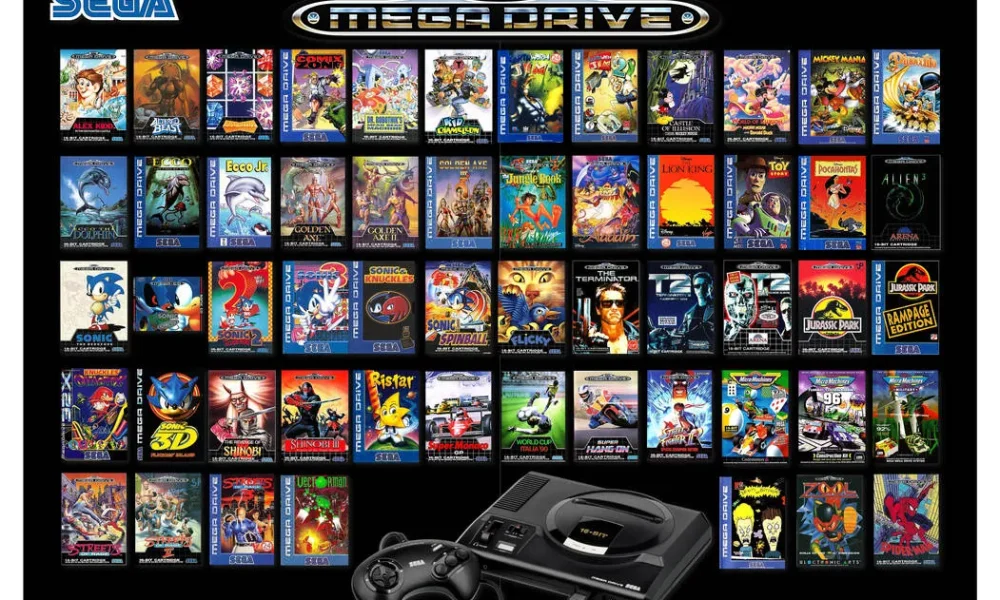
I loved my Mega Drive. That was my choice in 1991, aged eight, standing in Dixons with birthday money burning a hole in my pocket and a decision to make that felt, at the time, roughly as consequential as choosing a career. My mate James had a SNES. My cousin had a SNES. Sonic the Hedgehog was on a demo unit in the corner of the shop, running at a speed that made Mario look like he was wading through custard, and that was that. Sega. Done. I have never once regretted it (and then got a SNES as well).
The Mega Drive — Genesis if you’re reading this from across the Atlantic — was Sega’s masterpiece. Faster processor than the SNES, a grittier aesthetic, and a library of games that leaned hard into action, attitude, and arcade-perfect ports. It didn’t have the RPG depth of Nintendo’s machine (mostly), and it lost the sound chip war by a country mile, but what it did have was an identity. The Mega Drive was the cool console. It was the one your parents weren’t sure about. And the games… the games were extraordinary. Here are the best of them, grouped loosely by genre, from someone who wore out two controllers and still has the six-button pad in a drawer somewhere. If you’re curious about where the Mega Drive fits in the evolution of gaming consoles, it sits right at the point where Sega briefly ruled the world.
Platformers & Sonic
The Mega Drive was Sonic’s house, and Sonic was Sega’s entire personality. But the platforming library ran far deeper than one blue hedgehog, even if he was the reason most of us bought the console in the first place.

Sonic the Hedgehog 2 — The best Sonic game, and I will not be taking questions on this. Chemical Plant Zone, the introduction of Tails, the spin dash, and a final boss fight against a giant mech in space. It perfected the formula that Sonic 1 established and did it with a confidence that bordered on arrogance. Two-player split-screen was ropey but we played it anyway, because it was Sonic and it was 1992 and nothing else mattered.
Sonic the Hedgehog 3 & Knuckles — Technically two games that lock together into one massive adventure, and the combined package is a staggering achievement. Fourteen zones, three playable characters, save files (a luxury on the Mega Drive), and a soundtrack partly composed by Michael Jackson, which Sega have never quite admitted to. The Mushroom Hill and Sandopolis zones are peak 16-bit design.
Sonic the Hedgehog — The original. Green Hill Zone’s opening seconds are seared into the memory of every Mega Drive owner — that first loop, the ring sound, the sheer velocity of it all. It’s simpler and slower than its sequels, and Labyrinth Zone can do one frankly, but as a statement of intent it was flawless.

Rocket Knight Adventures — Konami’s armoured possum with a jet pack deserved to be a mascot-level character. Tight controls, inventive boss fights, and a mix of side-scrolling action with horizontal shoot-em-up sections that kept you guessing. It’s better than most people remember, and the sprite work is gorgeous.
Ristar — Sega’s own late-era platformer about a stretchy-armed star, released in 1995 when the Mega Drive was already being replaced by the Saturn. Criminally overlooked. The grab-and-swing mechanics feel unique even now, the visual design is extraordinary for the hardware, and each world has a completely different gimmick. One of the great “what if?” games — imagine if this had launched in 1992 instead.
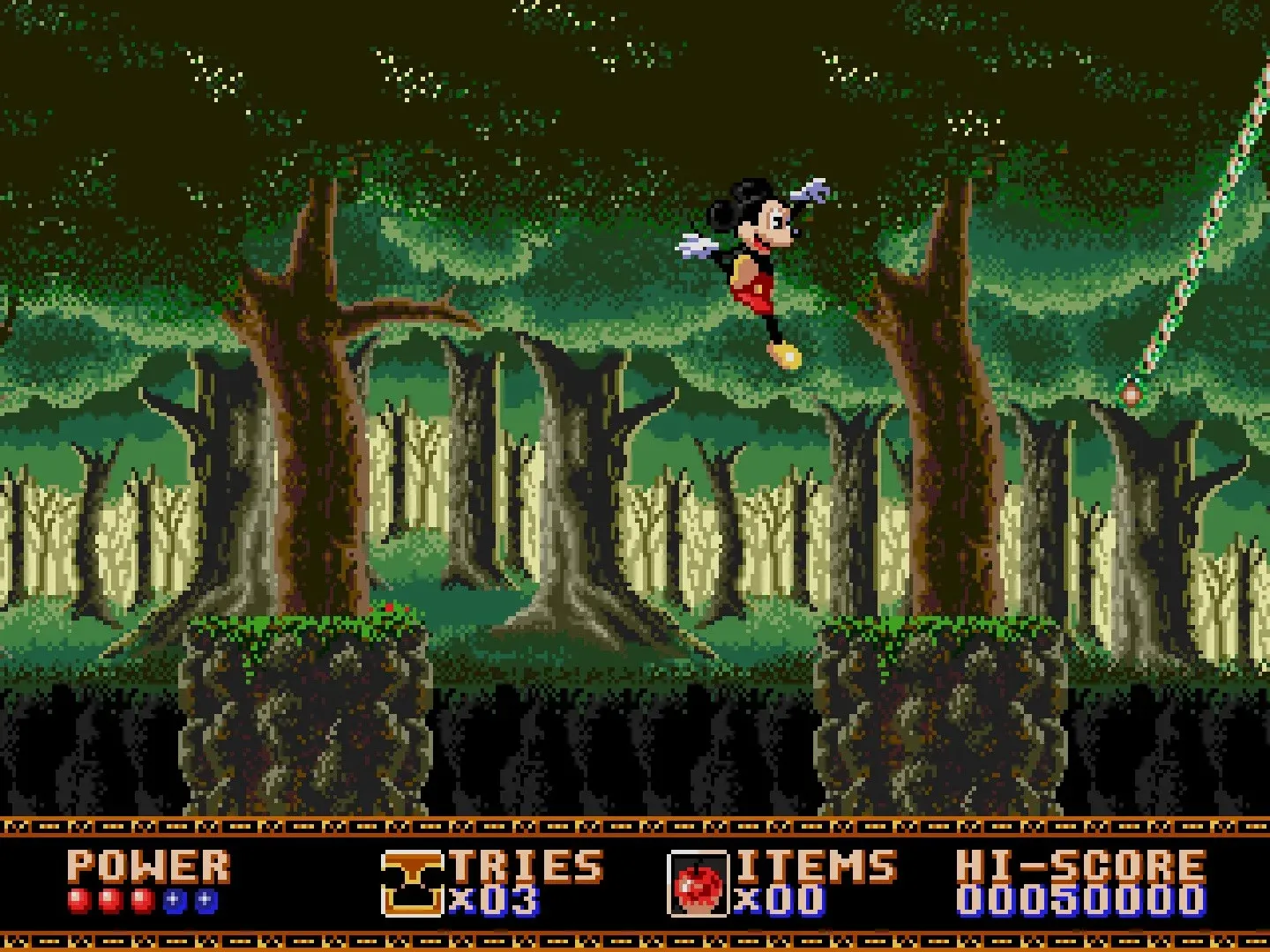
Castle of Illusion Starring Mickey Mouse — Before Disney’s gaming output became a running joke, Sega made this gorgeous platformer that held its own against anything in the genre. Tight level design, creative bosses, and a charm that transcended its licence. The apple-bouncing mechanics in the first world are pure joy.
Action & Brawlers
If the SNES was the RPG console, the Mega Drive was the action console. Faster processor, punchier sound effects, and a library of brawlers, action games, and side-scrollers that hit harder than anything Nintendo’s machine could muster.

Streets of Rage 2 — The finest side-scrolling beat-em-up ever made, full stop. Four characters, each with a distinct moveset, a soundtrack by Yuzo Koshiro that remains the best collection of electronic music ever composed for a video game, and co-op that turned an excellent game into an unforgettable one. The pipe-wielding enemies on Stage 1 still trigger muscle memory in my thumbs. If you play one game on this entire list, make it this one.
Gunstar Heroes — Treasure’s debut game and an absolute masterclass in action design. Four combinable weapons, a throw mechanic that turned enemies into projectiles, boss fights that escalated from challenging to completely unhinged, and a board game level that somehow worked. The seven-boss dice palace is one of the most inventive sequences in 16-bit gaming. A co-op essential.
Shinobi III: Return of the Ninja Master — The best ninja game on the Mega Drive, with a fluidity of movement that made Joe Musashi feel genuinely deadly. Horse-riding stages, surfboard sections, and wall-running that Sega nailed decades before it became a standard action game feature. The difficulty is firm but fair, and the soundtrack is outstanding.
Comix Zone — A beat-em-up set inside the panels of a comic book, where you literally tear your way between frames. The concept was brilliant, the art direction was stunning, and the difficulty was absolutely savage. You got one life, no continues, and roughly forty minutes of gameplay that most people never saw the end of. Cruel, beautiful, unforgettable.

Golden Axe — Sega’s fantasy brawler was an arcade staple before it came home to the Mega Drive, and the port was excellent. Three characters, rideable dragons, and those little gnome creatures you kicked to steal their magic potions. Co-op Golden Axe was a rite of passage in the early ’90s. The sequel was decent, but the original had a purity that the follow-ups couldn’t quite recapture.
Alien Soldier — Treasure’s boss-rush masterpiece, released only in Japan and Europe. Twenty-five boss fights connected by short corridor sections, a counter-dash mechanic that rewarded aggression, and a difficulty level that made Gunstar Heroes look gentle. It’s not for everyone, but for the action game connoisseur it’s sacred text.
Shooters & Shmups
The Mega Drive’s faster processor made it the natural home for shoot-em-ups, and the library in this genre was extraordinary — particularly the Japanese imports that PAL gamers had to hunt down through mail-order catalogues.

Thunder Force IV (Lightening Force) — The pinnacle of horizontal shooters on the Mega Drive. Multi-scrolling backgrounds that pushed the hardware to its limits, a weapon system with real depth, and a soundtrack that redefined what the Yamaha sound chip could produce. The opening stage, with its parallax thunderstorm, is one of the most visually impressive moments on the console.
M.U.S.H.A. — Compile’s vertical shooter is fast, frantic, and dripping with mecha anime style. The options system gives you tactical flexibility mid-stage, the difficulty curve is expertly judged, and the sprite work is among the finest on the system. Copies are expensive now, and justifiably so.
Vectorman — BlueSky Software’s pre-rendered 3D run-and-gun was Sega’s answer to Donkey Kong Country, and while it didn’t shift the same cultural weight, the game underneath was superb. Sixteen stages of tight platforming and shooting with a transforming protagonist, gorgeous visual effects, and a funky soundtrack. Both Vectorman games are worth your time.

Contra: Hard Corps — Konami’s Mega Drive entry in the Contra series went completely unhinged — branching paths, multiple endings, four playable characters, and boss fights that filled the screen with so many sprites the console had a small breakdown. Brutally hard in the Western version (which removed the hit points the Japanese version had), but extraordinary.
RPGs & Adventures
The Mega Drive’s RPG library was thinner than the SNES’s — that’s just a fact. But what it had was quality, and a couple of these stand toe-to-toe with anything on Nintendo’s machine. For more on the genre’s golden age, our retro RPG rankings cover the broader 16-bit picture.
Phantasy Star IV: The End of the Millennium — Sega’s space-opera RPG series reached its peak with this gorgeous, cinematic finale. Manga-style cutscenes, a macro system that let you program combo attacks, and a story that tied together the entire Phantasy Star saga. It’s the best RPG on the Mega Drive by a comfortable margin, and one of the finest JRPGs of the 16-bit era full stop.

Shining Force II — A tactical RPG in the Fire Emblem mould, with a huge overworld, dozens of recruitable characters, and satisfying grid-based combat. It’s more accessible than its contemporaries — no permadeath, generous progression — which makes it an ideal entry point for the genre. The promotion system, where characters change class at level 20, gives real long-term motivation.
Landstalker — Climax’s isometric action RPG was ambitious, inventive, and occasionally infuriating thanks to its tricky perspective. But the dungeons were clever, the world was charming, and the platforming-in-3D-before-3D approach was genuinely ahead of its time. Think Zelda meets Marble Madness, with better writing than either.
Beyond Oasis (The Story of Thor) — Sega’s answer to A Link to the Past, with fluid combat, elemental spirit companions, and some of the smoothest animation on the console. It was beautiful, it was fun, and it deserved a bigger audience than it got. The PAL title — The Story of Thor — is significantly better as a name, for the record.

Ecco the Dolphin — Not an RPG, but absolutely an adventure, and one of the most singular games on the console. You play a dolphin exploring increasingly surreal oceanic environments, solving sonar-based puzzles, and eventually travelling through time to fight aliens. Yes, really. It was atmospheric, gorgeous, and disturbingly difficult. The sequel, Tides of Time, expanded the formula, but the original’s eerie tone has never been matched.
Sports & Racing
EA Sports practically built its empire on the Mega Drive, and the racing library was stuffed with arcade-perfect ports and original gems. These are the ones that still hold up when you dig the console out.
Road Rash II — Motorcycle racing with fists, chains, and police chases. Road Rash was always more about the violence than the racing, and the second game perfected the formula — two-player split-screen, bigger tracks, and the sublime satisfaction of punching a rival off their bike at 120mph. Nothing in modern gaming has recaptured this particular flavour of chaos.

Micro Machines 2: Turbo Tournament — Top-down racing across kitchen tables, bathtubs, and garden paths using tiny toy vehicles. The J-Cart version had two extra controller ports built into the cartridge itself, allowing four-player races without a multitap. The track design was fiendishly clever, and the multiplayer was responsible for more broken friendships than any other game on the Mega Drive.
ToeJam & Earl — Technically a roguelike disguised as a funk-infused alien adventure, which is a sentence that only makes sense in the context of early ’90s Sega. Two aliens crash-land on Earth and must collect pieces of their spaceship across randomly generated levels populated by insane humans. The co-op is legendary, the tone is completely unique, and the soundtrack slaps in a way that no other Mega Drive game even attempted.
FIFA International Soccer / FIFA 95 — EA’s football series started on the Mega Drive, and while FIFA 95 was the first with real club licences, the original isometric FIFA had an immediacy that later entries lost. The Mega Drive versions had a speed and responsiveness that the SNES ports couldn’t match, and for a certain generation, this was where football gaming began.

Super Hang-On — Sega’s arcade motorcycle racer, ported beautifully to the Mega Drive with a career mode that the arcade lacked. The sense of speed was phenomenal, and selecting your soundtrack before a race was a touch of class that set the tone for every playthrough. Pure arcade pleasure.
Hidden Gems & Cult Classics
Every console has games that slipped through the cracks — titles that the magazines gave seven out of ten and everyone forgot about, only for collectors to rediscover them years later and wonder how they’d been sleeping on something this good.

Dynamite Headdy — Treasure’s platformer about a puppet with a detachable head that could swap between sixteen different head types. It was weird, it was inventive, and the boss fights were spectacular. The Western version was rebalanced to be harder, which was a questionable decision given that the Japanese version was already no pushover.
Soleil (Crusader of Centy) — A Zelda-style action RPG about a boy who gains the ability to talk to animals but loses the ability to talk to humans. Charming, inventive, and criminally unknown. If you like A Link to the Past, you’ll love this.
Quackshot Starring Donald Duck — A globe-trotting platformer starring Donald Duck in an Indiana Jones-style adventure. It had a plunger-gun mechanic, non-linear progression between stages, and more charm per pixel than most games manage per polygon. Sega’s Disney output in the early ’90s was consistently excellent, and this was the peak.

Mega Turrican — Factor 5’s run-and-gun brought the Amiga classic to the Mega Drive with a grappling beam, enormous levels, and Chris Huelsbeck’s legendary soundtrack. It sat between Contra’s intensity and Metroid’s exploration, and the result was something rather special.
Flashback — Delphine Software’s rotoscoped sci-fi platformer was like playing a film. The animation was extraordinary for 1993, the story was genuinely compelling, and the adventure-game puzzles gave it substance beyond its gorgeous presentation. Prince of Persia’s cooler, more ambitious cousin.
Light Crusader — Treasure again, this time with an isometric action RPG that mixed real-time combat with physics-based puzzles. It divided opinion at launch — too short, some said, too simple — but the atmosphere and puzzle design hold up remarkably well. Treasure could apparently make anything.
The Mega Drive library is deeper than people give it credit for. Yes, the SNES had more RPGs. Yes, Nintendo had Mario. But Sega had speed, attitude, and a willingness to take risks that produced some of the most distinctive games of the 16-bit era. The console that gave us Sonic, Streets of Rage, and Gunstar Heroes deserves its place in history, and if you’ve still got one gathering dust in the attic… plug it in. These games are waiting. Find more retro rankings in our retro gaming series, and remember — Sega does what Nintendon’t. Always did.

Frequently Asked Questions
What is the best Mega Drive game of all time?
Streets of Rage 2 and Sonic the Hedgehog 2 are the two most common answers, and both are justified. Streets of Rage 2 has the edge for its flawless co-op, Yuzo Koshiro’s soundtrack, and the depth of its combat system. Sonic 2 wins on cultural impact and pure platforming design. You can’t go wrong with either.
Is the Mega Drive the same as the Genesis?
Yes. The Sega Mega Drive was the console’s name in Europe, Japan, and most of the world. In North America it was called the Sega Genesis due to trademark issues with the name “Mega Drive.” The hardware is identical, though cartridges are region-locked by the shape of the cartridge slot — PAL, NTSC-U, and NTSC-J carts are physically different.
How many Mega Drive games were released?
Approximately 900 games were officially released across all regions. The North American Genesis library was the largest at around 700 titles, while the PAL region received roughly 500. Japan had a number of exclusive titles, particularly shoot-em-ups and RPGs, that never made it to the West.
What is the best way to play Mega Drive games in 2026?
The Analogue Mega Sg is the gold standard for original cartridges on modern displays — FPGA-based, pixel-perfect, and lag-free. The Sega Mega Drive Mini 2 is an excellent plug-and-play option with a curated library. Nintendo Switch Online’s Expansion Pack includes a growing selection of Mega Drive titles. For originals on a CRT, a Model 1 Mega Drive with a good SCART cable is still the purist’s choice.
Was the Mega Drive more powerful than the SNES?
It depends what you mean by powerful. The Mega Drive had a faster main CPU (7.6 MHz vs 3.58 MHz), which made it better suited to fast action games and shoot-em-ups. The SNES had a superior graphics chip with more colours, transparency effects, and Mode 7 rotation, plus a dramatically better sound chip. In practice, each console had strengths the other couldn’t match.
Why are Mega Drive cartridges getting expensive?
Retro gaming has boomed as a collector’s market, and the Mega Drive is no exception. Games like M.U.S.H.A., Mega Turrican, and Alien Soldier had limited print runs and now command serious prices. Even common titles have risen steadily. Flashcarts like the Mega Everdrive offer a legal-grey-area alternative for playing the library without breaking the bank.
Did the Mega Drive or SNES win the console war?
Globally, the SNES outsold the Mega Drive — roughly 49 million to 30 million units. But the Mega Drive won North America for several years before the SNES caught up, and in Brazil the Mega Drive was so dominant it’s still manufactured today. In the UK, it was genuinely neck and neck. The real winner was gamers — the competition pushed both companies to produce extraordinary software.
Latest






Latest Previews
Lost Gems
-

Top 10 Meta Quest 2 Games For Children
-
Stormforce Gaming & The Prism iCue 6209
-
Licensed Xbox Games for Kids 2022/23
-
New Mods for Minecraft Bedrock 2023
-
The 6,6,6 Scariest Games of 2022
-
5 Great Udemy Courses For New Game Developers
-
Hearthstone Alternatives For Lovers of Card Games
-
My Top 10 Star Wars Games of All Time
-
5 of the Most Interesting Mobile Games at EGX Rezzed
-
11 Wicked Witches in Video Games | Halloween Special
-
Beginners Guide to Pokemon Go [Updated]
-
Advanced 2D and 3D Game Development Software
-
My Top 5 Boxing Games
-
Parents Guide to Minecraft
-
10 Great Kids Games From 2016 on Xbox One












You must be logged in to post a comment Login